
OEE: how to measure the efficiency of your factory
Share:
If you have a company, being competitive isn’t an option, it’s a necessity. Even more so today, in a context where new innovations, competitors and disruptives technologies emerge every day. For this reason, every company should make improving the efficiency of its operations one of its priorities.
Productivity isn't just about working an eight-hour day, but maximizing performance and the value generated during that time. Unlike areas such as education, where effectiveness can be measured directly by the number of pages learned over a given period of time, the industrial environment needs a more complex approach
The solution is not simply to measure the number of units produced over a given period of time; it encompasses more elements. So, within a company and its production processes, how can we measure this efficiency? In today’s article, we talk about OEE, a fundamental metric in the manufacturing industry.
What is it and why is it important?
OEE stands for Overall Equipment Effectiveness, a metric used for measuring the overall effectiveness of equipment, a production line or an entire plant, and to improve the process productivity. This metric shows the degree to which equipment is being used effectively relative to its maximum theoretical potential.
It’s one of the most used indicators within the manufacturing industry, since it makes it possible to monitor the effectiveness of a company's production and identify potential inefficiencies during the manufacturing process.
Its calculation combines three dimensions: availability, performance and quality. Each one of them represents a different category of operational losses:
- Availability. This is the amount of time that a work team is available for production.
- Performance. This is the amount of work a team performs within a given period of time.
- Quality. This is the number of products that have been produced in accordance with established standards, that is, that are acceptable.
How to calculate the OEE
The formula to calculate the efficiency of your production processes is simple:
OEE= Availability x Performance x Quality
As we explained earlier, each element of this formula represents a dimension of operational efficiency. By multiplying the three, we can obtain a comprehensive assessment of productivity at an industrial plant. Let’s now look at what each element represents:
- Availability (producing in the expected time). This represents the ratio of the time a piece of equipment has been productive to the total time available for a given production period. This factor can be affected by downtime due to breakdowns, delays, etc.
- Performance (working at the correct speed). It measures if the team has produced at the ideal speed. It is the ratio of the real production to the production capacity for a given period of time. To calculate it, it is important to know the number of units produced in relation to the maximum production capacity during that period.
- Quality (to manufacture correctly the first time ). It is the proportion of acceptable products in relation to the total that has been produced. It means, it is the ratio of good production to real production. It can be affected by defective parts.
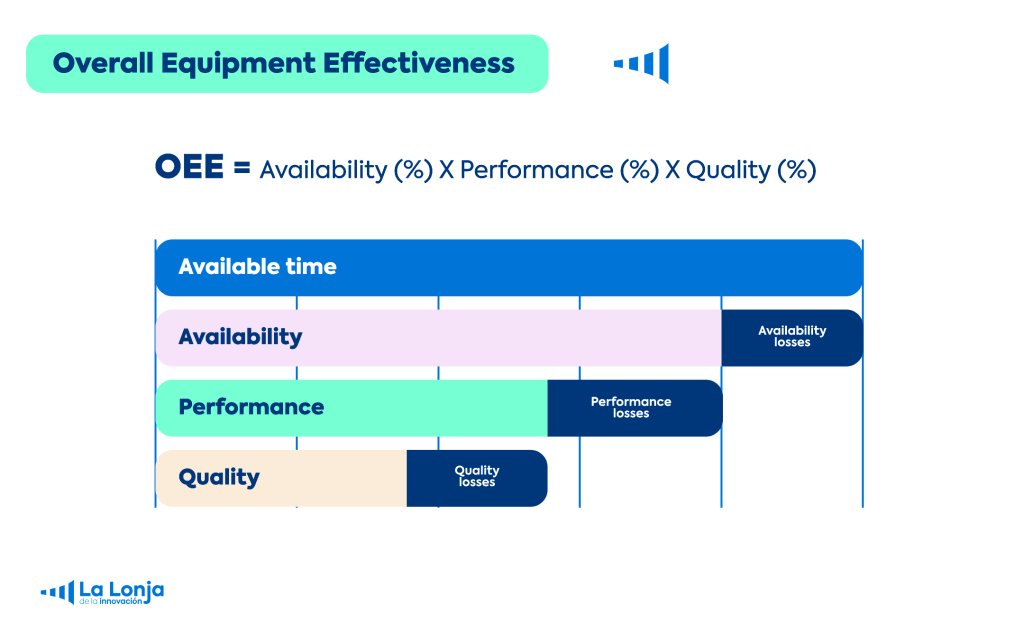
Furthermore, to calculate OEE correctly, it’s important to have information about other aspects of your production processes, as these will allow you to determine your availability, performance and quality:
- Downtime: minutes of work lost due to stops, breakdowns, waits, incidents, etc.
- Planned production time: period during which the machine or equipment should be producing.
- Operating time: planned time minus downtimes.
- Total production: total number of units manufactured in the analyzed period.
- Good production: number of units meeting specifications without rework.
- Ideal cycle time: theoretical time required to manufacture one unit under optimal conditions.
Everything is better understood with an example, so let's walk through one. Imagine your company has an 8-hour production shift (480 minutes). During this shift, there are about 40 minutes of downtime for adjustments and breakdowns, 15 minutes for machinery cleaning, and 20 minutes for shift startup and shutdown—meaning there is a total of 75 minutes of downtime. This reduces the operating time to 405 minutes (480 - 75). With these figures, we can calculate Availability = 405 / 480 = 84.4%.
On the other hand, your company's ideal production cycle allows you to produce 1 piece every 30 seconds. That means:
405 minutes of operating time x 60 seconds = 24,300 seconds
24,300 seconds / 30 seconds = 810 pieces.
That is to say, the ideal scenario would be manufacturing 810 quality pieces throughout the shift. However, due to various stoppages, only 780 pieces were actually manufactured during that time. This information allows us to calculate Performance = 780 / 810 = 96.3%.
Now we can move on to calculating quality. If we assume that out of the 780 pieces manufactured, only 745 were usable, Quality = 745 / 780 = 95.5%. Now we have all the information to apply the OEE formula and determine efficiency.
OEE = 84.4% x 96.3% x 95.5% = 77.62%
How do we interpret this result?
- OEE score= 100%: maximum quality, zero errors, and maximum speed. An idealized situation far from reality.
- Above 85%: very high value, a long-term goal for many. Good coordination between production, quality, and maintenance.
- Between 60% and 70%: the most common range, with margin for improvement and optimization.
- Below 60%: clear need for performance improvement; process bottlenecks must be analyzed and action must be taken.
Now that you know how to calculate OEE, what are you waiting for to evaluate the efficiency of your processes?